
Have you ever felt unheard, dismissed, or invalidated growing up? Or experienced feelings of numbness, guilt, or loneliness? Are you struggling to make sense of how you feel?
You may have experienced emotional neglect which is the absence of emotional attunement and the absence of being seen, heard, and emotionally understood. Emotional neglect is not about what happened, it’s about what didn’t happen. Because of this, it can be difficult to recognize or put into words. Because of this, many survivors begin to grieve the childhood they should have had if it weren’t for their childhood trauma.
You may love your parents but still feel hurt, or you may feel guilty even reading this post. This is completely normal and doesn’t diminish your goodness or who you are.
In the South Asian community, there is often emphasis on academic achievement, reputation, and obedience, and emotional needs are often minimized or sacrificed as a result. Research suggests that childhood emotional neglect can impact emotional development, including difficulties with social connection and emotional awareness.
In this post I discuss what emotional neglect is, signs you may have experienced it, why it’s common and what it can look like in South Asian households, what it can look like when needs are not met, and how to heal from it.
This post is for informational and educational purposes only and is not a substitute for professional mental health support. If you’re struggling, consider reaching out to a licensed therapist or a trusted support system.

What is Emotional Neglect?
Emotional neglect is a pattern where an individual’s emotional needs are consistently not being met. It often occurs in childhood between a caregiver and child, where a child often feels like they are unloved, invalidated, or their emotions don’t matter.
There are three kinds of caregivers that show emotional neglect:
- Lack of awareness caregivers: Well intentioned, but blind caregivers who may have experienced neglect themselves and therefore may not have the tools to provide emotional support.
- Limited capacity caregivers: Caregivers who are struggling (i.e. with substance abuse or severe stress), who may not have the ability to provide emotional support.
- Self-focused caregivers: Narcissistic caregivers who prioritize their own needs over their child’s emotional well-being.
Emotional Neglect vs. Emotional Abuse
Emotional neglect is a passive inaction from the failure to act or provide emotional support. It’s invisible and could be unintentional.
Emotional abuse is an active pattern of harmful behaviours such as manipulation, control, or verbal harm, that negatively impacts a person’s emotional well-being. Although it can be intentional, it may also occur without full awareness.
There are no physical scars for both emotional neglect and emotional abuse, but only psychological ones.
Examples of Emotional Neglect
- Lack of interaction: Consistently being busy and unresponsive when a child is trying to communicate
- Unnoticed emotions: Ignoring a child who is upset instead of providing comfort to them
- Lack of validation: Failing to acknowledge a child’s achievement
- Invalidation of feelings: Telling a child who is upset that they are “too sensitive”
- Punishment of emotions: Giving a child the silent treatment when they act out
- Withholding affection: Failing to provide comfort or warmth even when asked
Signs You May Have Experienced Emotional Neglect

It’s hard to identify signs of emotional neglect as it’s invisible to the child experiencing it and outsiders. It often includes the absence of emotional attunement rather than clear harmful actions. Signs show up in different ways including how you feel, or changes in the way you act.
- You may have difficulty identifying emotions
- You may detach from your feelings
- You may feel disconnected
- You may experience low self-worth and self-blame (I explore this further in Why do Survivors Blame Themselves)
- You may prioritize people-pleasing
- You may have difficulty trusting others
- You may have difficulty regulating emotions
- You may feel lonely even when you have people around
Why Emotional Neglect is Common in South Asian Families
Intergenerational Trauma and Lack of Awareness
Many parents who have experienced emotional neglect themselves may struggle to recognize and validate their children’s emotional needs, often passing down unhealthy coping mechanisms unknowingly.
South Asians may be unaware that emotional needs should be prioritized, as they were raised in an environment where mental health was often dismissed. This is something I discuss more in Mental Health in the South Asian Community. Because of the emotional neglect and lack of emotional discussion they’ve experienced in their upbringing, they may not even have the awareness that something is missing.
Survival Mentality
Many South Asian parents have survived wars, displacement, and other economic hardships. Due to the nature of these struggles, they tend to prioritize survival over emotional needs. Emotional distress is likely seen as trivial when compared to the harsh, many times, life threatening conditions they’ve endured.
South Asian families may show love in other ways, including things that are in line with a collectivist mindset such as cooking, or things that are seen as essential for success such as education or extracurriculars.
Prioritize Family Reputation
Family reputation and obedience is often prioritized over an individual’s well-being and needs. When a child has a specific emotional need, it’s likely to be ignored or dismissed if it doesn’t benefit the family as a whole or can harm their reputation.
Love may sometimes feel conditional where it is only shown when a child’s actions benefit the family’s reputation or their academic success, but is withheld when these conditions are not met.
What Emotional Neglect Can Look Like in South Asian Households

In many South Asian households, emotional neglect can occur when a child’s emotions or choices conflict with parental expectation.
- It can look like conversations focused only on academics or success
- It can sound like “What will people think”
- It can be receiving praise only when things go well
- It can be the silent treatment as punishment
- It can be distant parenting (rarely hearing “I love you”)
- It can involve comparison to other children
What Happens When Emotional Needs Are Not Met?
When emotional needs are consistently unmet, the effects often show up in how you see yourself, process emotions, and relate to others.
Impact to Self-Worth
When emotional needs are not met by parents, children often grow up believing that their emotions and needs do not matter, lowering their self-worth and triggering self-blame. Individuals often feel a loss of personal identity, face intense personal criticism, and insecurities may surface, including thoughts of never feeling good enough.
These patterns are not unique to emotional neglect and can also be seen in other forms of childhood trauma (such as Long-term Effects of Childhood Sexual Abuse), where unmet emotional needs continue to impact self-worth into adulthood.
In their search for emotional validation, those with fragile self-worth may develop protective behaviours such as perfectionism, overcompensation, or emotional defensiveness.
Emotional Disconnection
Emotional disconnection is a coping mechanism where individuals face difficulties identifying, processing, and addressing their own emotions or the emotions of others. When emotional needs are not met, individuals may suppress their emotions, often disconnecting from their own feelings. In turn, they may experience loneliness and build emotional walls because their feelings may begin to feel like burdens.
Relationship Patterns
Partners may feel unseen or invalidated due to a loved one’s emotional neglect, making it difficult to form healthy relationships. A lack of emotional safety during childhood can cause difficulties with trust, people-pleasing, and vulnerability in future relationships. (I discuss this in my post How Childhood Trauma Affects Relationships in Adulthood).
Anxiety + Resentment
Although emotional neglect is invisible and forms from emotional inactions, deep-rooted anxiety and resentment can build over time and alter relationships with those who were supposed to provide care.
Anxiety can form as a result of:
- Never feeling good enough to have your needs met
- Feeling like your emotional struggles are a burden
- Feeling on edge
- Experiencing intense reactions to small stressors
- Constantly overthinking due to difficulties trusting your own instincts
Resentment can form as a result of:
- Grieving the parents you wish would validate your feelings
- Grieving the childhood you never had
- Anger over the inability to express yourself as a child
- Deprivation of emotional support they should have received
These emotional responses are common across many types of unresolved trauma. If you relate to these patterns on a deeper level, you may also find it helpful to explore Healing from Childhood Sexual Abuse, which shares additional ways to process and heal from early emotional wounds.
Why You Might Feel Ungrateful Talking About Emotional Neglect

Conversations about emotional neglect are rare, and people often walk away feeling as though they’ve crossed a line by bringing it up. This is because these traumatic experiences are not visible, and therefore hard to validate. Many times, physical needs are being met by caregivers, so children may find it hard to discuss what is missing emotionally. Gaslighting is also common, where a survivor’s self-worth is lowered, often leaving them to feel like their emotional needs don’t deserve to be addressed or taken seriously.
Many children struggle to hold both love and hurt at the same time, where it can feel contradictory. They may love their parents, yet also resent them for not validating or meeting their emotional needs. This creates a desire for closeness with the same person who is emotionally unavailable. As a result, positive moments can feel intensely uplifting, whereas negative ones can feel extremely painful.
Understanding emotional neglect helped me view my parents with compassion, while still acknowledging the grief I carried over some of their decisions. I explore that balance in The Grief No One Warned Me About During Healing.
South Asian Context
The South Asian community emphasizes a collectivist mindset where actions that benefit the whole group are prioritized. Discussing emotional neglect is often personal and has the opposite effect of the collectivistic mindset. In the community, sacrifice is often normalized as it’s seen as a sign of love and commitment. Due to this, children may feel like they need to dismiss their emotional needs for the good of the community.
Many South Asians have experienced war, displacement, or scarcity, and children may compare their emotional needs to their parents’ past struggle for survival. They may conclude that their emotional needs are selfish when comparing it to fleeing a war.
Children may also see the financial assistance, education, and food their parents provide, and believe that asking for emotional support is ungrateful, asking for too much, or even demanding.
How Emotional Neglect Affects Adult Relationships
Emotional Disconnection
In relationships, emotional disconnection can show up as difficulty expressing feelings, feeling numb, defensive, or finding distractions to avoid talking about their feelings.
As a result, they may avoid intimacy, feel uncomfortable when cared for, and may even find comfort in leading overly dependent or independent lives with their partners. Partners may in turn feel like roommates in a routine-based relationship which can feel lonely and unseen.
Fear of Rejection and Relationship Anxiety
Individuals who have experienced emotional neglect often enter adulthood with a fear of rejection or anxiety within their relationship. Due to the low self-esteem developed from their childhood neglect, they may experience rejection sensitivity, hyper-sensitivity, or even self-sabotaging behaviours in their intimate relationships. They may in turn naturally attract emotionally unavailable partners because that’s all they know.
Over-Adapting to Others
Children who had their emotions dismissed or ignored were often taught that their emotional needs were inferior to others, causing them to struggle with prioritizing others, setting boundaries, and feeling an overwhelming sense of being a caretaker.
In an effort to create a sense of safety and stability, they may focus on the needs of others and avoid potential conflict at the expense of their own mental health. Many people may also blindly follow their partners’ interests out of ease or because they feel that their wants are “too much,” as it was depicted in childhood.
Over-adapting can shift the balance in relationships, leaving one partner feeling like they’re always giving more. It often leads to a loss of personal identity, and individuals become overly focused on others’ needs. This can result in resentment or loneliness when their own needs go unmet.
How Do You Heal Childhood Emotional Neglect?

Due to its complexities, healing from childhood emotional neglect varies between survivors. If you’re looking for a structured approach, you can read How to Start Healing from Childhood Trauma (step-by-step).
Ways of Healing
- Practice self compassion
- Acknowledge and validate your emotions
- Set boundaries
- Build emotional awareness
- Practice self-care and grounding techniques
- Seek therapy or support (I discuss this further in the post Therapy: Is it for you?)
- Express your needs clearly
- Identify and unlearn patterns
- Practice inner child work
What Healing Looks Like in a South Asian Context
Balancing Culture and Personal Growth
Many South Asians are highly influenced by a culture that prioritizes communal and academic achievement. Balancing the needs of culture while simultaneously “filling your own cup” can be hard when the needs of each group seem to contradict one another.
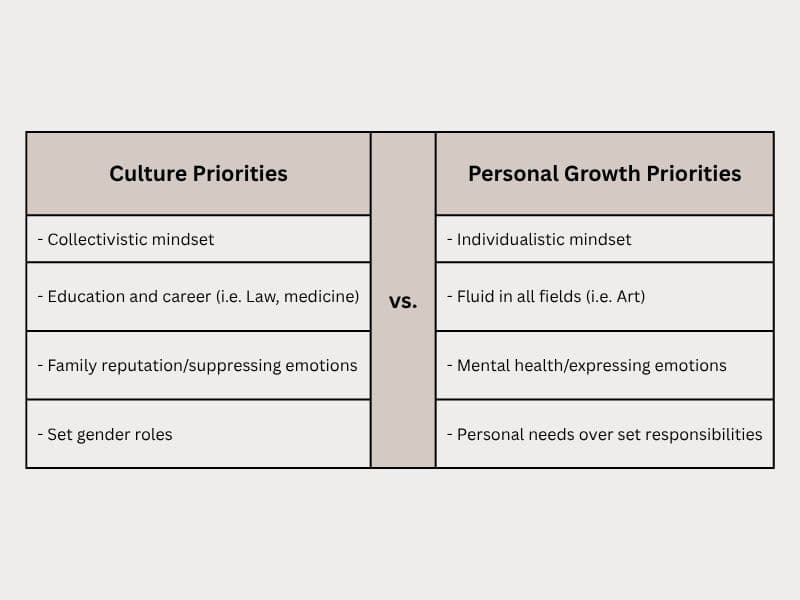
Finding a balance between the two can greatly support healing from emotional neglect as it can foster sustainable relationships.
- Take small steps, as large, sudden actions may feel overwhelming and seem like rebelling
- Engage in open conversation about mental health and the stigmas that exist (I explore this deeply in the post Cultural Stigma in the South Asian Community)
- Set firm boundaries
- Seek culturally sensitive therapy
- Reflect on the cultural values you want to keep that also support personal growth and emotional needs
Prioritizing your personal well-being does not mean that you don’t respect or love your culture. Both things can be true at the same time.
Redefining Respect and Boundaries
In the South Asian community, respect towards others is prioritized, and boundaries are often ignored. To heal from emotional neglect, individuals need to expand the idea of respect to include self-respect and shift from people-pleasing to maintaining essential boundaries.
Redefining respect is moving from a collectivistic, silenced mindset, to one that prioritizes personal well-being and also considers cultural values. It can be done through normalizing personal boundaries, encouraging open conversations around mental health, and openly naming intergenerational struggles while actively finding ways to break cycles.
Breaking Generational Patterns
To heal from emotional neglect, you must focus on moving away from unhealthy generational patterns, even though it may feel uncomfortable. Breaking these patterns allows you to create a new “normal” that prioritizes your emotional needs and creates a new standard for future generations.
- Become educated on emotional neglect and common coping mechanisms
- Acknowledge your emotional neglect experiences
- Name your suppressed emotions to get the validation you’ve never received
- Understand your coping mechanisms used (i.e avoidance, emotional disconnection)
- Set healthy boundaries that support your emotional needs
- Practice self-compassion especially when things go off track
Final Thoughts on Emotional Neglect
Your emotional needs matter, which is why it can be deeply painful when they’re not met. Experiences don’t define who you are and the feelings that come from it are valid. Although you may feel guilt, shame, or fear by not blindly following cultural practices, it’s possible to find a balance where you acknowledge your pain without rejecting your roots. You are more than your experiences (read You Are More Than Just Your Abuse).
Patterns that have formed from emotional neglect are not failures or permanent, and can be changed with acknowledgement, understanding, and gentle practices. A crucial part of healing is consistently practicing self-compassion, even when situations may make it feel impossible.
Healing is always possible, and starts off with awareness. Reading this post may mean that you’re already aware that your needs aren’t met, and that’s a powerful first step! Giving yourself grace, and embracing your journey will attract opportunities to form healthier relationships and live a more meaningful life that prioritizes your needs.
Your needs matter, your growth is limitless, and you deserve to be cared for.