A Gentle Note Before You Read
This post discusses childhood sexual abuse, trauma, and the healing process. I share both educational information and personal reflections in hopes of creating conversation and understanding. These topics can be emotionally heavy, so please read at your own pace and take breaks if needed.
Healing from childhood sexual abuse is complex, very personal, and often lifelong. Abuse is something that should never happen to begin with, and every survivor’s experience and healing journey looks different.
Healing itself can feel just as difficult as the abuse, especially because childhood sexual abuse often leads to long-term emotional and psychological effects. These can include depression, anxiety, self-blame, insomnia, and feelings of hopelessness. I discuss these impacts in more depth in my post on the long-term effects of childhood sexual abuse and trauma.
The most important priority is always the survivor’s wellbeing, not the abuse itself. If you want to learn about my personal experiences around admitting my abuse, read Why It Took Me So Long to Admit It Was Abuse.

IN THIS GUIDE, YOU’LL LEARN
What is Childhood Sexual Abuse?
Childhood sexual abuse occurs when a minor is involved in sexual activity with an adult or another child for the sexual stimulation of the perpetrator. According to RAINN, childhood sexual abuse can have long-lasting emotional and psychological impacts. While many people associate sexual abuse solely with physical acts, abuse can also be verbal, emotional, or psychological in nature.
Because of trauma responses and survival mechanisms, it is very common for survivors not to recognize that abuse occurred until much later in life, sometimes well into adulthood. This delayed awareness does not make the abuse any less real or valid.
Why Healing from Childhood Sexual Abuse is Not Linear

Healing from childhood sexual abuse is not straightforward or predictable. Many survivors desperately want to move on and “get over” what happened, but if healing were that simple, no survivor would still be struggling.
A common misconception is that healing follows a straight upward path. In reality, healing often comes in waves. Progress can ebb and flow, with no fixed timeline or process for when or how a person will heal.
Triggers can bring survivors back into emotional spirals at any time. These triggers might include:
- Seeing the abuser or someone who resembles them
- Hearing a name, word, or phrase
- Certain smells or environments
- Returning to places connected to the abuse
It’s possible to feel stable for weeks or months, only to feel overwhelmed again in an instant. This does not mean healing has failed. It just means trauma is complex.
During my early therapy sessions, I often left feeling hopeful and empowered, only to wake up the next day feeling the opposite. The progress I thought I had made sometimes felt like it disappeared overnight. These emotional swings are incredibly common and often misunderstood.
If you think about it, in order to heal from abuse, you will need to relive a part of your past that was very traumatic. Healing requires revisiting painful memories, understanding how trauma impacts the brain, and slowly processing experiences that were once too overwhelming to face. This is why many survivors feel worse before they feel better.
In addition, factors such as a lack of support system and the unique experiences of each survivor can also contribute to a non-linear healing process. There is no one-size-fits-all approach to healing. Just like every individual is unique, every survivor responds and heals from trauma in their own way. What helps one survivor may be triggering for another. Even what works for you today may not work tomorrow, and that is okay. Healing requires patience, flexibility, and self-compassion.
Methods of Healing from Childhood Sexual Abuse

There are many tools to support healing from childhood sexual abuse. Some survivors use several, while others find one or two that work best. Access varies, but healing options always exist.
Common Healing Tools for Survivors
- Therapy, especially trauma-informed therapy (explored further in my post Therapy: Is It for You?)
- Journaling to safely process thoughts and emotions
- Support groups for childhood sexual abuse survivors
- Grounding techniques such as sight, sound, touch, smell, taste (discussed further in my post 5 Grounding Exercises That Help Me)
- Setting boundaries to protect emotional wellbeing
- Learning about trauma and how it affects the brain
- Creative outlets such as writing, art, or movement
What Healing from Childhood Sexual Abuse Can Look Like Over Time
Recovery from childhood sexual abuse is not black and white and looks different among individuals. According to the NIH, any positive change after trauma is considered growth and every survivor heals differently. Healing does not erase what happened. Instead, it helps survivors reclaim their lives and sense of self.
Signs of healing
- Setting and maintaining healthy boundaries
- Fewer panic attacks or emotional spirals
- Increased self-compassion
- Accepting the abuse without letting it define your identity
- Regulating emotions more effectively
- Talking about the abuse without spiraling
- Taking steps toward therapy
- Needing therapy less frequently over time
- Reading this post
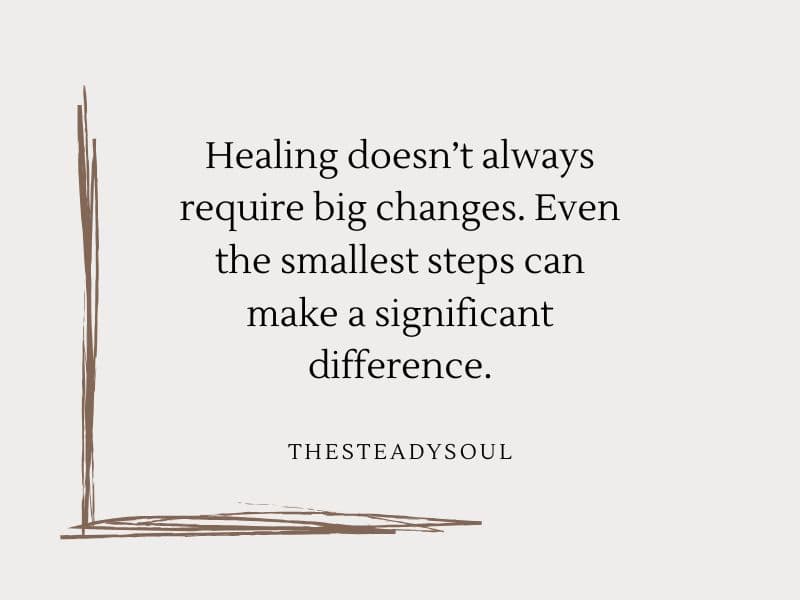
Healing doesn’t always require big changes. Even the smallest steps can make a significant difference.
Reassurance That Survivors Are Not Broken
One of the most common beliefs among survivors of childhood sexual abuse is the feeling that they are broken. Over time, I’ve learned that this belief is partly true in a very important way: you will never be the same person you were before your abuse. But that does not mean you are damaged.
You are changed. Often, you become stronger, more self-aware, and more resilient.
It’s completely normal to experience setbacks throughout the healing process. Trauma is isolating, and when the people around you can’t fully relate to your experience, it’s easy to assume that something must be wrong with you. Many survivors internalize this belief and begin to see themselves as the problem that needs to be fixed. But healing looks different for everyone. Just because you haven’t yet found what works for you does not mean you won’t.
Many survivors struggle with self-blame after abuse. For a long time, I believed something was wrong with me. I carried immense self-blame and convinced myself that I was the issue. It took time, reflection, and therapy for me to understand that what happened to me was not a reflection of who I am, it was a reflection of my abuser.
Healing requires patience and a willingness to acknowledge the trauma while slowly working toward recovery. Until that acceptance begins, it’s common to feel broken. Only after I fully accepted that I had been abused, was I able to shift my mindset from self-blame to self-compassion.
The Blank Piece of Paper Analogy

Imagine a blank piece of paper. It is smooth, clean, and free of marks. Now crumple that paper into a tight ball, then slowly open it back up. The paper is no longer smooth. It has creases and bends that cannot be fully erased. No matter how hard you try to smooth it out, you will never get it to look like it did before.
But its purpose has not changed. You can still write, draw, create something with it. The paper is not broken, it simply looks different.
This is how I now view myself as a survivor. At my core, I am still the same person. I am not broken, I have been shaped by my experiences. After my abuse, I stopped seeing myself as someone who lost everything. Instead, I began to see myself as someone with strength, resilience, and a deeper sense of purpose.
I explore this idea further in my post You Are More Than Just Your Abuse.
You are not broken. You are becoming the next, more powerful version of yourself, at your own pace.
Final Thoughts on Healing from Childhood Sexual Abuse

Healing from childhood sexual abuse is not linear, but every step forward matters. Even just considering healing takes strength. Progress may come with setbacks, but each effort builds resilience and moves you closer to reclaiming your life. Support from loved ones can also play an important role in recovery. I talk more about this in How to Support Someone Who Has Experienced Childhood Sexual Abuse.
It’s very important to remain patient even when patience feels impossible, and to celebrate all wins, no matter how small they may feel. Every step counts. You are not broken. You are healing, and that alone is powerful.
If this topic feels overwhelming or brings up difficult emotions, you can visit the Resources & Crisis Support page for additional support options.
Gentle Disclaimer
This post is based on my personal experience and is not medical or professional advice. Healing from childhood sexual abuse looks different for everyone. If you feel overwhelmed, unsafe, or in need of immediate support, please consider reaching out to a mental health professional or a trusted support resource in your area.
Frequently Asked Questions
How long does it take to heal from childhood sexual abuse?
There is no fixed timeline for healing from childhood sexual abuse. Some survivors may begin processing their trauma fairly quickly, while others may need years before they feel ready to fully face and work through their experiences.
Healing is very personal and often unpredictable. It is normal for progress to come with setbacks, making it difficult to determine how long healing may take.
The most important part of recovery is moving at a pace that feels safe and manageable for you. Small steps toward healing, taken consistently over time, can make a significant difference.
Is it normal to struggle years after childhood sexual abuse?
Yes. It is very common for survivors to experience emotional and psychological effects of childhood sexual abuse long after the abuse has ended.
Childhood trauma is complex and can affect many areas of a survivor’s life, including trust, relationships, mental health, self-compassion, and personal identity. Because trauma has many layers, some effects may not fully surface until years later. Struggling later in life does not mean healing has failed, it simply reflects the lasting impact trauma can have.
Do survivors always need therapy to heal?
No, therapy is not the only path to healing from childhood sexual abuse. While trauma-informed therapy can be extremely helpful for many survivors, recovery looks different for everyone.
Some survivors benefit from a combination of healing methods, such as journaling, support groups, education about trauma, or creative expression. I explore this further in my post How to Heal Without Therapy. What matters most is finding healing tools that feel safe, supportive, and effective for you.
There is no single “right” way to heal.
Can survivors fully recover from childhood sexual abuse?
Healing from childhood sexual abuse does not erase what happened, but it can change how deeply those experiences affect your life.
Over time, many survivors learn how to process their trauma, develop healthier coping strategies, and rebuild their sense of self. Healing can lead to greater self-compassion, resilience, and personal growth. Survivors may begin to see themselves with more understanding and kindness than they were able to before.
Recovery is not about forgetting the past. It is about reclaiming your life and learning to move forward with strength and self-awareness.
Why is healing from childhood sexual abuse so difficult?
Healing from childhood sexual abuse is difficult because trauma impacts the brain, emotions, and sense of safety and control. Survivors are often forced to process experiences that were confusing, or impossible to understand during childhood.
Many survivors also carry feelings of shame, self-blame, or fear for years before recognizing the abuse. Because trauma can impact trust, relationships, and mental health, healing often requires time, patience, and support. Even though the process can feel overwhelming, recovery is possible with the right tools.
–