
A Gentle Note Before You Read
This post discusses childhood trauma and healing. Please read at your own pace and take breaks if needed. Your safety and well-being come first.
Healing from childhood trauma is complex and deeply personal. There is no single path or approach that works for everyone. Because of the many differences between survivors and experiences, healing is not straightforward and can be lifelong.
Although it may take days, months, or even years to begin seeing progress, the healing journey can be deeply rewarding and meaningful. It takes a tremendous amount of courage and strength to begin healing, which is why even the thought of it should not be dismissed. Healing can help you uncover that you are more than just your abuse.
Healing is not a race or a checklist where progress is guaranteed as soon as you check off each item. It takes time, patience, and everyone moves through it differently. If anything in this post feels overwhelming, take a break if you need to. The healing journey works best when you move at your own pace.

In This Guide, You’ll Learn:
- What is childhood trauma
- Signs you may be carrying childhood trauma
- How childhood trauma can affect you as an adult
- Why healing matters
- 10 steps to start healing from childhood trauma
- Common mistakes to avoid
- What if you’re not ready to heal yet
- How long does healing from trauma take
- Gentle daily practices to start today
What is Childhood Trauma?
Childhood trauma is a deeply distressing experience that a child (under the age of 18) goes through. This experience can impact their sense of safety, their ability to cope, or their bodily and emotional integrity. An event does not need to occur multiple times to be considered traumatic.
Trauma can be emotional, physical, or psychological and can include abuse, neglect, violence, household dysfunction and emotional invalidation.
It can lead to long-term effects including anxiety, depression, PTSD, and impacts on brain development.
Signs You May Be Carrying Childhood Trauma

It can be difficult to identify signs of childhood trauma because many are not visible and instead show up mentally or emotionally.
- You may feel overwhelmed, even by small things
- You may feel helpless, like there is no light at the end of the tunnel
- You may feel shame guilt or self-blame (I discuss this more in my post Why do survivors blame themselves after childhood sexual abuse)
- You may feel confused about your emotions
- You may feel emotionally numb
- You may feel like you’re navigating this experience on your own
- You may constantly feel on edge
- You may experience intrusive memories
- You may have intense emotional reactions or difficulties regulating your emotions
- You may dissociate from your surroundings
- You may act from fear-based thinking driven by anxiety or your need for control
How Childhood Trauma Can Affect You as an Adult

Childhood trauma has the unique ability to quietly sneak up on survivors as they take on adulthood. After the abuse, it can linger in the background, making subtle changes that often go unnoticed due to the lack of cognitive development within children. Children, at the time of the trauma, may not have been able to process it appropriately, and may have subconsciously suppressed traumatic memories.
As survivors grow older and begin to understand their experiences, suppression may no longer work, leading them to avoid these memories instead of facing them directly.
Relationship Struggles
Survivors may notice changes in how they handle relationships, including difficulties with trust, setting boundaries or people-pleasing. Some may push loved ones away, while others may feel a strong need for closeness.
Unhealthy Coping Mechanisms
When suppression no longer works, survivors may turn to unhealthy coping mechanisms including substance abuse, unhealthy relationships with food, negative self-talk, escapism, or withdrawal. These may provide temporary relief but are not helpful long term.
Mental Health Challenges
Childhood trauma can significantly impact mental health including anxiety, depression, and PTSD, which I discuss further in Long-Term Effects of Childhood Sexual Abuse: A Survivor’s Perspective.
Because these challenges are not always visible, many survivors struggle to put a name to what they are feeling. Without support, these struggles can intensify over time.
Feeling Stuck or Lost
Many survivors want to move forward but don’t know where to begin. This can lead to feeling stuck, lost, or disconnected from life. They may function day-to-day but feel held back internally, which can affect self-worth. Thoughts like “I am not enough” or “I am at fault,” may consume them, even though they are not true.
If any of this feels familiar, it’s not because you’re broken. It’s because your mind and body learned how to survive, and healing is possible.
Why Healing from Childhood Trauma Matters

Healing from trauma can help you regain a sense of control. It’s very hard to live your life to its full potential without some sort of healing. You deserve the opportunity to experience life with more peace and stability. The journey can be difficult and requires patience, and it’s normal to feel worse before feeling better. According to Mind Peace Psychology, healing doesn’t mean there will be no pain. It means learning to respond to distressing situations with self-compassion, healthy boundaries, and supportive strategies.
Healing is not just about processing past pain. It’s also about building a sense of safety, stability, and control in your present life.
Healing is not immediate, and its timeline varies from survivor to survivor. If you’ve been working towards your healing journey but feel like you haven’t seen much progress, that is completely normal. There is a good chance that you have made meaningful changes without knowing it.
Some of the benefits of healing include:
- Improved physical and mental health
- Increased resilience
- A more positive outlook on life
- Moving away from survival mode
- Feeling safer in your own body
- Improved quality of life
- Feeling more free
- Healthier relationships
Before beginning my healing journey, I constantly felt weighed down and drained. It impacted every aspect of my day, and I struggled to separate my trauma from my day-to-day activities. I often felt like I couldn’t give my full energy to anything because this trauma was always looming in my head.
As I began healing, I still felt those same emotions, but something shifted. I had support, and over time, I started trusting my ability to handle difficult moments on my own. Over time, I got to see firsthand how every aspect of my life changed for the better. That’s when I realized healing wasn’t about needing less help overnight, but gradually building the tools to support myself.
10 Steps to Start Healing from Childhood Trauma

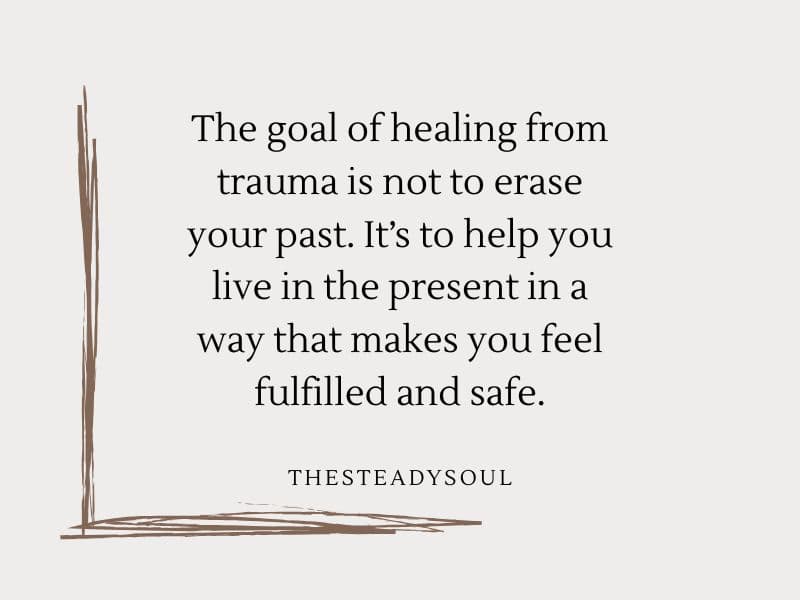
The goal of healing from trauma is not to erase your past. It’s to help you live in the present in a way that makes you feel fulfilled and safe despite the impacts of your childhood trauma. Healing often begins with small, intentional steps.
Now that we’ve explored what trauma is and why healing matters, here are practical steps to help you begin.
Step 1: Acknowledge what happened
One of the most important steps is recognizing that abuse occurred without minimizing your experience. Many survivors struggle with this, which can make healing feel out of reach.
Although it may feel uncomfortable, acknowledging parts of your experience can help validate what you went through, something that many survivors have been looking for but have struggled to find.
If you are not ready to do this yet, that is completely okay.
Step 2: Acknowledge the full impact of trauma and understand it wasn’t your fault
It can help to recognize that you were never at fault. Childhood trauma is never the fault of a child, even if self-blame feels automatic. Read that three times over.
It can also help to acknowledge the full impact that the trauma has had on your life. If you’re like me and have experienced trauma in the past, there is a good chance that your past experiences have had an impact on your present behaviours. Understanding your patterns and trauma triggers, while safely challenging them as they arise is an important part of healing.
As you try different coping strategies, notice what triggers you and what helps. This can guide you toward what works best for you.
Step 3: Learn about trauma
Many people are not educated on trauma including what it is, what can cause it, the signs, and how to begin healing. Education is power, and due to the lack of education, survivors tend to struggle with the impact of trauma longer than they might have if they had the knowledge earlier.
Understanding trauma can help you feel validated in your experience and know you are not alone. It can reduce shame and build the self-compassion you need to heal. It can help you connect patterns between your past experiences and current behaviours. This awareness can help narrow which coping strategies may be most effective for you and where to begin.
Knowledge reduces shame and can help survivors gain their power back.
Step 4: Allow yourself to feel
Healing involves sitting with difficult emotions and stepping outside the comfort you’ve created to safely process them.
Suppressing emotions can keep you feeling stuck. Expressing your emotions can help you move forward without the constant feeling that something is holding you back. Feel your emotions in the way that feels right for you. Whether it’s crying alone, crying to a loved one, or journaling, releasing these emotions can feel therapeutic and is necessary in this journey. You’ve experienced a lot, it’s okay to let things out.
Taking breaks when you feel overwhelmed is also part of the process. The goal is to be the most comfortable you can in an uncomfortable situation.
Step 5: Start small
It can help to begin with small, manageable steps rather than diving into the most difficult parts of your experience right away.
You might start with coping mechanisms that are not directly related to your trauma including journaling, grounding techniques, breathwork, or basic self-care. If you are speaking to someone, you can begin with topics that feel easier to talk about before moving into heavier ones. For example, when I began therapy, I started off talking about my relationship with my parents as it had an indirect impact on my traumatic experience.
Small steps can create great impact.
Step 6: Set Boundaries
Boundaries help create a safe and peaceful environment for healing. This journey is about you and boundaries help you remove excess noise and protect your energy.
You can set boundaries with anyone including those who may have caused harm. You are not limited in who you set a boundary with, or what kind of boundary you set with them. Your boundaries can change at any given moment, and you do not need to justify them.
Always keep in mind: Boundaries protect you and your healing journey.
Step 7: Practice self-compassion
The most important part of healing is being kind to yourself and leading with self-compassion. Self-blame can feel easier, but self-compassion is what supports long-term change.
Practicing self-affirmations or speaking to yourself with the same kindness you would offer a child are great tools to practice self-compassion. Try replacing negative thoughts with 3 more supportive ones. You may have setbacks where you revert to feelings of self-blame, but recognizing, acknowledging and giving yourself grace is also taking steps towards self-compassion.
Step 8: Reconnect with your inner child
Trauma can take away parts of your childhood. This is an unfortunate, yet completely common part of experiencing childhood trauma. Reconnecting with your inner child can help you rebuild that sense of self.
- Revisit activities you enjoyed as a kid including art, sports, music.
- Write to your younger self and let them know that things are going to be okay.
- Talk to yourself the way you would speak to a child. It can help you feel more compassion for the person you were when the trauma occurred and allow you to see your experience through a different lens. You may begin to better understand your reactions and choices from that time.
Step 9: Find safe support that you can test out
There is no universal approach to healing. Every survivor is different and will find that different support strategies will work better than others.
Some common coping mechanisms include:
- Therapy (I explore this further in the post Therapy: Is it for you?)
- Support groups
- Creative outlets including arts, writing, dance, cooking, photography, etc
- Self-care practices
It’s okay to try different approaches and step away from those that do not feel right. Remember, this is your journey and the only right way to heal is to use safe support strategies that feel best for you.
Step 10: Be patient with your healing and continue with self-compassion
Consistency matters more than speed. You may not see much progress at first, but over time, you will look back on your journey and realize that small changes can add up. Patience, although it may feel impossible, is key.
- Stay consistent with boundaries
- Continue practicing self-compassion
- Distance yourself from what harms you
Healing is not linear, which I discuss further in the post Healing from Childhood Sexual Abuse: A Survivor’s Guide, and setbacks are part of the process.
Common Mistakes to Avoid
While healing is personal, there are some common patterns that can slow progress.
- Forcing yourself to heal
- Comparing your journey to others
- Expecting healing to be linear or fast
- Avoiding honesty about your experience
- Holding onto self-blame
- Trying to fix everything at once
Healing takes time, patience, and self-compassion. Allowing it to unfold naturally will do wonders to your mental health and healing.
What if You’re not Ready to Heal Yet?

It’s okay to not feel ready. You are in the driver’s seat of your healing journey. You get to dictate the pace, and what matters first is your safety.
In the meantime, focus on what brings you peace and fulfillment. You can gradually introduce small practices such as journaling or learning about trauma when it feels right. These steps, although they may feel small, can make significant changes to your mindset.
You may find that through reading or education, you naturally start to let go of the self-blame you’ve put on yourself, which in itself is a natural and meaningful step towards healing.
How Long Does Healing from Childhood Trauma Take?

There is no set timeline. Healing can take days, months, or years depending on the person and their experiences.
In fact, it’s completely normal to feel worse before feeling better, especially when facing emotions that have been suppressed. Healing is possible with time, patience and consistent effort.
One thing I wasn’t prepared for after taking those first steps was the grief that surfaced once I finally felt safe enough to process my past. I share more about that experience in The Grief No One Warned Me About During Healing.
You may feel progress one day and setbacks the next. This is part of the process, which is why it’s important not to rush it.
In the beginning you may require constant and frequent support. But over time you may rely less on external support and more on the tools you have developed. According to MTIEC, healing doesn’t mean full freedom from the impacts of your childhood trauma. It’s having the ability to live in the present without being negatively impacted by your past experiences.
Healing looks different for everyone, and it rarely follows the path we expect. If you’re curious about what the process actually felt like for me, I share my personal experience in What Healing Actually Felt Like (It Wasn’t What I Expected).
Consistency is key in one’s healing journey. You may notice small progress here and there, but one day you will look back and realize the change was a lot bigger than you realized in the moment. This is the power of healing.
Gentle Daily Practices to Start Today

Daily practices can support your healing and build self-compassion.
- Journal
- Practice positive affirmations
- Use grounding techniques (explored further in my post 5 Grounding Exercises That Help Me During Anxiety)
- Try breath work
- Write down three things you are grateful for before you start the day
- Practice self-care (movement, rest, time outside)
- Stay hydrated
Working on yourself and building small habits daily can help you move forward with intention and a specific purpose.
Key Takeaways
- Healing from childhood trauma is personal and there is no single path that works for everyone
- Healing is not about erasing your past, but learning how to support yourself with more stability and safety over time
- It’s normal for healing to feel slow, non-linear, and even overwhelming at times
- Small, intentional steps can create meaningful progress over time
- Self-compassion is one of the most important tools in the healing process
- Understanding your trauma can help reduce shame and build awareness of patterns and triggers
- You do not have to be ready to face everything at once as healing happens at your own pace
- Progress may look like needing less external support and developing tools to navigate challenges on your own
Final Thoughts: You Deserve to Heal

Healing from childhood trauma is complex and takes time, but it is possible. Over time, you may notice a shift from self-blame to self-compassion and a stronger sense of self.
Rather than focusing on how long it takes, focus on consistency and self kindness. You’ll be surprised to see that progress will naturally happen.
You deserve the opportunity to heal and build a life that feels meaningful to you, despite the circumstances you’ve endured. Trauma may have shaped your experiences, but it does not define who you are.
Frequently Asked Questions
What are the signs of childhood trauma in adults?
Common signs of childhood trauma in adults can include :
Emotional: Feeling numb, overwhelmed, helpless, or experiencing self-blame
Physical and Mental: Intrusive memories, dissociation, or intense emotional reactions
Behavioural: People-pleasing and difficulty setting boundaries
Can trauma affect you if you don’t remember it?
Yes, it is very common for trauma to affect you even if you don’t remember it. The body and nervous system can hold onto past trauma, even when memories are unclear or suppressed. This is especially common in childhood, when experiences may not have been fully processed.
As survivors grow older, trauma may show up in other ways, such as anxiety or intense emotional reactions. Healing is still possible, even without clear memories of what happened.
How do you start healing from childhood trauma?
Healing often begins by acknowledging your experience and its impact, when you feel ready. You may start to notice patterns between your past experiences and your present behaviours, which can help build awareness.
It can help to start with small steps, such as journaling, grounding techniques, or breath work. Over time, you may explore additional support like therapy, support groups, or creative outlets. Most importantly, move at your own pace and practice self-compassion.
How long does healing from childhood trauma take?
There is no set timeline for healing from childhood trauma. Every survivor has different experiences, needs, and starting points, so the process can vary.
Healing is ongoing, and progress may feel slow at times, which is completely normal. Over time, many people find they develop the tools to rely less on external support and feel more confident navigating challenges on their own.
Healing only works when survivors move at a pace that feels comfortable to them.
Is it normal to feel worse before you feel better?
Yes, it is completely normal. Healing often involves processing emotions and experiences that may have been suppressed for a long time.
Feeling worse at times does not mean you are doing something wrong. It can be a natural part of the healing process.
Do I need therapy?
Therapy can be a helpful tool for processing and navigating trauma, but it is not required for everyone.
Some people find support through other methods such as support groups, creative outlets, breath work, or grounding techniques. The right approach depends on what feels safest and most supportive for you.
What if I’m not ready?
It is completely okay to not feel ready to heal. Healing cannot be forced, and your safety should always come first.
In the meantime, you can focus on small, supportive practices such as journaling, breath work, or self-care. These steps can still help you build a foundation until you feel ready.
Can childhood trauma be healed completely?
Yes, it is possible to completely heal from childhood trauma. Healing does not mean erasing what happened. Instead, it means reducing the impact trauma has on your daily life and building tools, resilience, and emotional stability.
Over time, many people reach a place where they feel more in control, at peace, and able to respond to challenges with self-compassion.